


The Fence before the Document!

By Arian Galdini
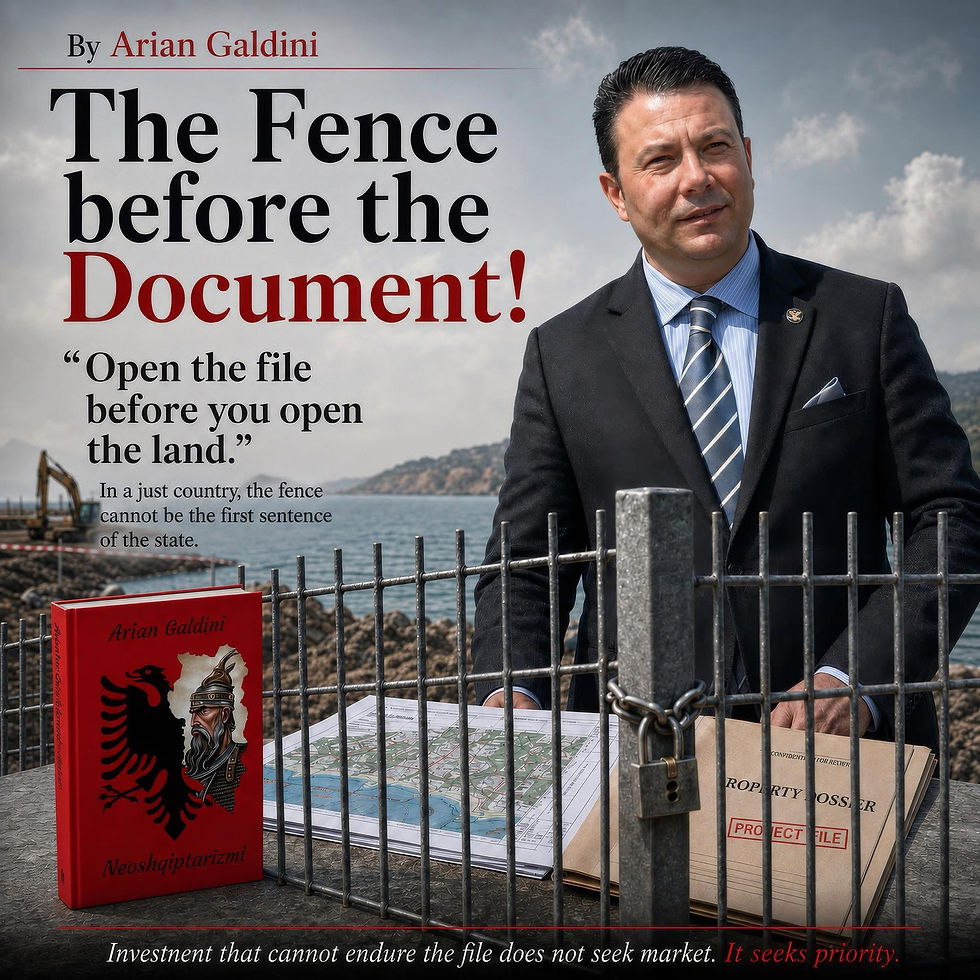
In a just state, the document comes before the fence.
When the fence comes before the document, development has begun to speak the language of occupation.
That is where the issue begins.
Not with the hotel.
Not with the name of the investor.
Not with the sum promised.
Not with the photograph of the project.
Where land is fenced off before the public has seen the file, the order has been overturned.
Justice comes late.
Explanation comes late.
The resident comes late.
The state, which should have appeared first with the law, appears first as the project’s facilitator.
Albania needs large investments, good tourism, serious capital, honest work, and a modern economy.
A country is not saved by seeing every investor as a threat.
But an investment does not become honest because the amount is large.
It becomes honest through the order by which it enters.
When money comes after clarified property, after the published permit, after the open map, after real public hearing, after environmental assessment, and after respect for the person who lived there before the project, it can become an opportunity.
When it comes in haste, with papers that are not seen, with residents who learn late, with companies that ask for more trust than verification, with a state that asks for calm before clarification, then we do not have development.
We have the fence before the document.
The fence is a cold thing.
It does not need many words.
It says: someone has already taken power over this piece of land.
It says, the project has entered the body of the country before the reason has been made public.
It says, the resident is not being called at the beginning as a person with rights, but at the end as an obstacle.
It says, the question did not come before the fact, it came after it.
The fence is not only a physical boundary.
It is the first sentence power says to the resident when it does not want to begin with explanation.
The fence does not enclose only the land.
It also encloses the moment when the citizen should have been heard.
A man may see the fence where yesterday he passed on his way to the olive tree, to the water, to his father’s grave.
He does not yet know what the file says.
He knows only that the iron arrived before the explanation.
Even if every claim of his must be proven, the state has no right to place him before a fait accompli.
The state must meet him with documents, not with a fence.
In Albania, property is not a cold matter of land registry.
It is a long history of injustices, expropriations, delayed returns, overlaps, lost documents, dubious decisions, families that have waited longer than any administration has had the patience to hear them.
That is why, whenever a large project touches land, the burden of clarity belongs to the state.
Not to the disoriented resident standing before the machinery.
The state must show the file before the land is fenced.
It must show the map before the machinery enters.
It must show ownership before it asks for trust.
It must show the permit before it asks for calm.
Open the file before you open the land.
That sentence should be enough.
An investment that cannot endure the file is not seeking a market.
It is seeking priority.
If the project is clean, the document does not harm it.
If ownership is clean, the chain has no reason to hide.
If the environment is not being damaged, the assessment must stand before the public.
If the resident is not harmed, the hearing must not take place after the decision has already become a fact.
Zvërnec, Rrjoll, Manastir, and every other place where a major project meets the people of the place are not merely points on a map.
Each case has its own documents, its own claims, its own procedures.
But in them the same suspicious order repeats itself, beauty appears as economic promise, capital approaches, the administration moves, the words “strategic,” “tourism,” “development,” “elite,” “employment” begin to produce calm; then the resident comes out into the road and asks for what he should have had from the beginning: explanation.
This is not a modern way to build.
It is an old way of asking for approval after the land has already begun to change.
First, beauty appears.
Then comes the desire to package it.
Then come the maps that few have seen.
Then the names of companies, sometimes clearer on paper than in real ownership.
Then the rule is softened, the passage is eased, the decision is accelerated.
Then the fence goes up.
After the fence, the resident appears and asks why he was not heard earlier.
In the end, power says: this is development.
But development is not a word that forgives procedure.
There is investment that builds, and investment that displaces.
There is tourism that honors a place, and tourism that uses the place as a backdrop.
There is capital that enters as a partner, and capital that behaves like the owner of silence.
There is a state that keeps the balance, and a state that clears the road for the strong, then asks the weak not to delay the future.
True principle does not measure development by the size of the investor, but by the security of property, the freedom of contract, and the ability of the state not to bow before the strong.
When the law bends before money, the market is not free.
It is captured with clean hands.
The coastline is not a warehouse of horizons.
It is not a row of plots waiting for the name of the next investor.
It is not a stage on which every government displays its own dream of luxury.
It is the most sensitive meeting between economy and memory, between beauty and use, between the person who lives there and the power that signs over him.
A country that recognizes no limit before its own territory will one day recognize no limit before its own human being.
The danger of today’s model is not that construction happens.
The danger is that construction appears as the right of the one who comes with the project, while the resident appears as the delay of the project.
The danger is not investment.
It is the moment when investment enters the land before right has entered the light.
This is an overturned order.
The government must not be the architect of mistrust.
It must not appear early to ease the project and late to clarify matters for the citizen.
It must not ask the resident to trust the word of the minister, the mayor, the investor, the office, or the television.
It must give him the document.
A serious state does not calm with declarations what it can clarify with papers.
If a project requires so much trust before it provides so little documentation, the problem is not the citizen’s suspicion.
The problem is the conduct of the state.
Albanian territory cannot be treated as a silent surface.
It has memory.
It has property.
It has waters, boundary stones, graves, trees, and names that do not appear in renderings.
When a large project enters without recognizing these things, it does not bring only development.
It brings organized forgetting.
A serious economy does not ask for a silent citizen.
It asks for a citizen who trusts that the law does not disappear when the project becomes large.
A serious investor does not ask to enter the memory of a country with a fence before the explanation.
He enters with a file, a contract, respect, and patience.
In Zvërnec, in Rrjoll, in Manastir, and wherever the Albanian coastline turns into a collision between the people of the place and the major project, it is not only tourism being tested.
What is being tested is whether Albania is still a country of its citizens, or only a beautiful shore that power prepares for whoever arrives with more power.
Albania needs investment.
But not investment that asks the citizen to be silent.
Not investment that finds property unclear and rushes forward before clarifying it.
Not investment that sees nature as an advertising backdrop and the resident as local noise.
Not investment in which the state appears zealous for the project and tired for the person.
True development does not require the state to withdraw from its own land.
On the contrary, where large capital enters, the state must become more present, more just, clearer, and harsher with the strong.
An investment that needs a silent citizen does not bring development.
It brings a new order over an old injustice.
In a just country, the fence cannot be the first sentence of the state.
Arian Galdini


Comments