


Why, in an age of blind acceleration, must LRE - Rinisja remain the voice of reason?


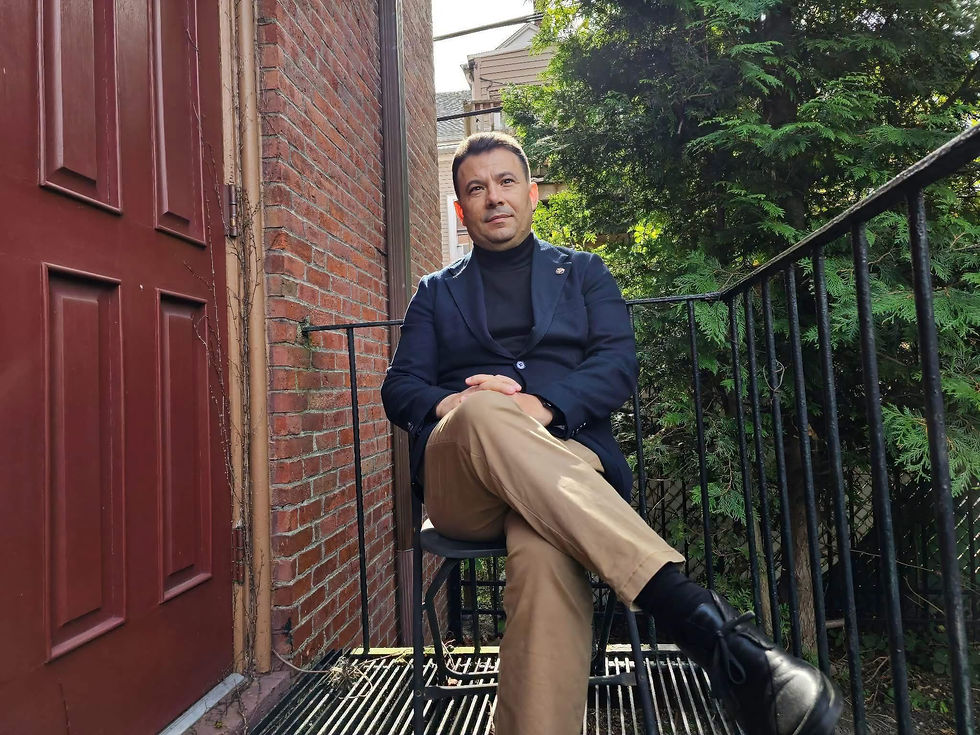
By Kristina Nano
Chair of LRE - Rinisja
LRE - Rinisja( Renewal Movement)
We live in a time when politics is compressed into thirty-second clips and forgotten within a twenty-four-hour news cycle. At that speed, democracies do not merely make mistakes, they lose their thread.
Ours is being tested from two directions at once. On one side, power begins to speak as the state itself, as though a mandate could turn a person into an institution.
On the other side, opposition dissolves into noise, as though the street’s temperature could replace method.
Between them stands the citizen: the one who pays taxes, raises children, absorbs the daily disorder, and asks for one simple thing, a republic that can be read.
That is the demand: a readable republic.
A republic becomes readable only when decisions carry a name, a responsible person, and a deadline, when a citizen can point to a document and say, plainly, this is who decided, this is what was promised, this is by when.
Strip those three words away and law turns ornamental, reform becomes a poster, protest a passing scene, and government a monologue about itself.
In these same evenings, the circle is tightening, not only around individuals, but around the way the state has been used. Investigations and precautionary measures are moving upward.
A major digital agency and senior officials are under scrutiny.
Anti-corruption prosecutors have moved from commentary to case files, and a special court has begun issuing decisions that freeze contracts, suspend tenders, compel testimony, on matters that, until yesterday, many dismissed as mere “political weather.”
On another track, the question of Belinda Balluku’s suspension has entered constitutional review.
And the very fact that the debate revolves around “limits” rather than the moral standard of governance reveals how easily separation of powers can slide when morality is left without a guardian.
Meanwhile, on the other side of the stage, calls for “final” protests return as a ready-made habit.
The street is declared a program, and adrenaline is marketed as a solution.
Society is invited to step into a film it already knows by heart.
Here is where we differ.
LRE - Rinisja stands clearly against Edi Rama and his model of governance, not as opposition for sport, but as a demand for standards.
When governance lives, day after day, under the shadow of files, measures, suspicions, and networks, trust dissolves.
In a small country, trust is the only real national capital.
People stop leaning on the law and begin leaning on chance.
And when a people leans on chance, it loses more than its economy, it loses its moral ground, because order starts to look naïve, and justice begins to look like a luxury.
Still, a real opposition is measured by more than what it says against power.
It is measured by how it opposes.
This is where reason separates from reflex.
Protest is a democratic right, it is breath. What deserves scrutiny is its use, protest that sets a standard, and protest that merely fills a square, creating motion while leaving the state unreadable.
There is protest that forces clarity, and there is protest that serves vagueness, because vagueness buys time for those who would rather avoid accountability.
Albania knows the ritual, ignition, collision, exhaustion, then a deal that never gets written.
Each time the temperature rises, the system finds a way to feed itself with noise.
If politics still contains wisdom, it should read this as a warning, not as a triumph.
That is why our question is not “for or against protest.”
Our question is, are we building pressure for standards, or are we building an alibi to return to the show?
Because the political show has become, over three decades of transition, Albania’s preferred way of avoiding real solutions.
The camera turns on, the grand sentence is spoken, a “historic” promise is made.
Then nothing follows, no document, no responsible name, no deadline.
The scene changes, the habits do not.
And when habits do not change, the bill arrives, not as a headline, but as emigration, cynicism, broken services, and a shrinking faith that anything can be fixed.
This reflex is not uniquely Albanian.
Latin America in the 1980s and post-Soviet Europe in the 1990s learned the same lesson: spectacle can be used to postpone accountability.
Fog becomes the permanent shelter of those who wish to avoid reckoning.
Look at it at eye level.
Picture a mother standing in a hospital corridor late at night, a folder in her hands, waiting for a signature that does not come, not because the law is absent, but because no one is named, no one is responsible, and no deadline binds anyone above her.
She does not need a slogan.
She needs a document, a name, and a clock that does not stop for the powerful.
Our road begins with a simple object, one that requires no philosophy, only responsibility, an ordinary written request, with a date, a stamp, and a name.
At the bottom sits a cold sentence: “Within ten days.”
That is where noise ends.
That is where the state begins.
Because “within ten days” is the boundary at which politics either becomes service, or admits it has become theater.
Here is our nail, our fixed point, the deadline.
When a society loses its thread, it finds it again through a written deadline.
A deadline is how procedure becomes civilization.
A deadline is how justice becomes tangible. A deadline is how transparency leaves the sentence and becomes a document.
Without deadlines, justice becomes waiting.
Without deadlines, transparency becomes promise.
Without deadlines, protest becomes ritual, until citizens quietly lower expectations instead of raising their voice.
This is not theory; it is method.
In practice, it means choosing paper over pyrotechnics.
It means filing a request that names an office, cites a rule, sets a ten-day deadline, and is made public, so that the institution must answer the citizen, not a crowd.
The point is not to shout louder.
The point is to leave no place to hide.
We have tested this road in real time.
When a senior appointment was pushed through in silence, we resisted the temptation to declare a “last battle” and flood the boulevard. Instead, we filed a three-sentence request naming the decision, citing the rule it violated, and giving the institution ten days to respond.
On day nine, the answer came, not because we sounded angrier, but because silence had become legally impossible.
Not every case ends this way, and not every answer is honest.
But each documented deadline tightens, even slightly, the space in which arbitrariness can hide.
That is where the counter-voice appears, reliably, whenever the temperature rises: “Today or never.” “We need fire.” “We need pressure.”
“The street solves everything.”
This voice is powerful because it is simple. Yet precisely because it is simple, it can become an alibi.
Because without deadlines, every “final” becomes a sequel. Without deadlines, every “solution” becomes performance.
Without deadlines, every “enough” ends in a new fatigue.
That is why LRE - Rinisja chooses to be an opposition with method.
It chooses to be the Dignitarian Right, a conservatism that starts from human dignity rather than tribal identity, that treats responsibility as strength and law as the shared line, as a discipline of public life, not as decorative language, pro life, pro family, pro work and property, pro faith, pro the West, and pro friendship with the United States as an alliance of values, not convenience.
For us, Neo-Albanianism is a culture of responsibility, a way of being Albanian that measures patriotism by fairness, competence, and care for the common good, not by slogans.
Stewardefiance, our word for stubborn public stewardship that refuses to look away, is a code of conduct, an everyday habit of answerability, not a banner to wave.
Our conservatism is care for the foundation, so that the new does not take our soul hostage.
And we are not immune to the temptation of urgency.
It is always easier to borrow the language of crisis than to build the discipline of deadlines.
We have not always succeeded.
There were moments when volume looked like courage.
The difference is not that we are better people, it is that we are trying to bind ourselves to methods that can outlive us.
This means something concrete, the state is repaired not with nerves, but with rules.
And in a democracy, rules are more than law. They include political morality, the morality that understands public trust is not a gift, but a contract.
As constitutional thinkers from James Madison to Hannah Arendt warned in different languages, the first step away from a republic is not the first abuse of power, it is the moment citizens accept that some people will never have to stand in the same line.
A normal republic has rules that do not move even when everything around it moves:
Justice investigates without fear and without exceptions for names, through evidence, not smoke.
Politics does not bargain with the process.
Political accountability comes first, because public trust moves faster than a final verdict.
Transparency arrives through documents and deadlines, not through beautiful phrases.
Public language keeps measure, because the state’s words are instruments, not ornaments.
Separation of powers protects the citizen, it does not shelter the party.
And every pledge binds itself to a deadline and a responsible name, because without that, every reform becomes a poster.
Either these rules become habits, or our children inherit a country where “law” remains a word for speeches and a rumor in everyday life.
This is why we demand Edi Rama’s departure. The problem is not an episode.
It is a model that turns morality into technique, and technique into alibi, a pattern in which each scandal is answered with a new procedure, a new commission, a new vocabulary, while genuine political accountability remains rare, and resignations become exceptions instead of standards.
No country is rescued by alibis.
Today, without theatrics and without hatred, we set three cold obligations, worthy of a normal republic:
Justice must do its work with professional calm, without dialogue with the grandstand, without fear of crowds, guided by evidence alone.
Parliament must restore oversight as a work-rule that produces documents, deadlines, and accountable names, because oversight without documents becomes performance.
The executive must recognize that public morality stands above the legal minimum, and that the standard of trust cannot be negotiated through vocabulary.
If these three pillars shift, Albania enters the next cycle.
If they hold, Albania gains something heavier than a day, it regains the thread.
And when others lose their thread and their patience, pushing the country toward the next collision, LRE - Rinisja chooses to hold reason as a discipline, with standards, with deadlines, with ethics, with the rule of law.
Only then does Albania step out of noise into an honest life, where law shields the weak, work carries honor, family remains the first institution of trust, and the West is a horizon of values, not a backdrop for speeches.
And this is our seal, stated simply, coldly:
Without deadlines, even truth becomes opinion, with deadlines, opinion becomes state, and a line on paper that even the powerful must stand behind.
Kristina Nano
Chair of LRE - Rinisja


Comments