


The right of the place. Property has an owner. A place demands stewardship.

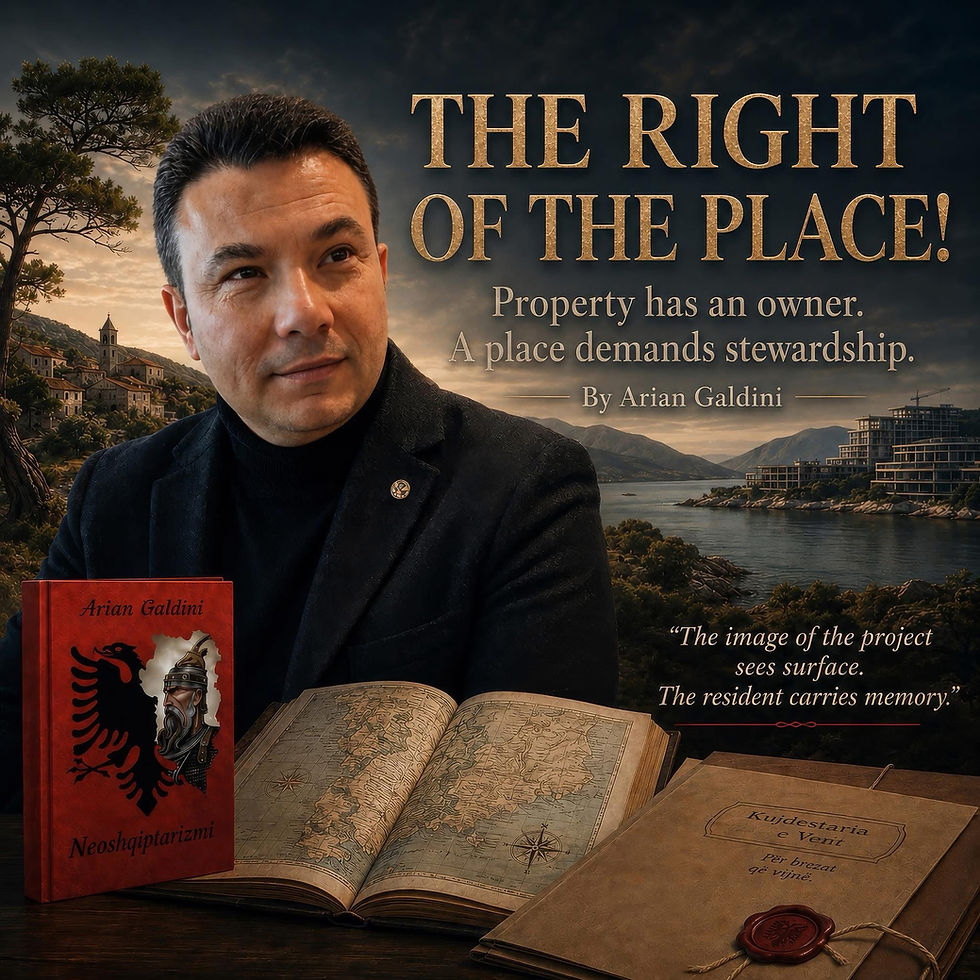
By Arian Galdini
A country does not lose only when its land is taken.
It also loses when the nature of its place is no longer recognized.
It loses when the shore, the mountain, the forest, and the village are no longer known as places with memory, but as surfaces waiting for a project.
It loses when the resident becomes a local voice, property an obstacle, the state a permit office, and the future only the image of a project.
Albania needs development.
This must be said without fear.
It needs capital, tourism, work, good construction, an open market, better services, and investors who do not come to use the country, but to create value within it.
But development is not sacred because it is called development.
It is tested by the way it touches the human being, property, nature, and tomorrow.
A large project does not enter emptiness.
It enters a place.
And place is not only surface.
It has memory, property, waters, roads, graves, boundary stones, trees, families, work, names, landscape, old silences, damaged histories, long waiting, and wounds the image of the project cannot see.
The image of the project sees surface.
The resident carries memory.
A state that listens only to the image of the project loses the language of its own land.
A man may return to the shore where he knew where the wind came from before rain, where the water opened its own road after winter, where a low stone showed him the boundary more precisely than a map.
He may find the same land, but no longer the same place.
Then the loss is not only legal.
It is older, the human being is no longer recognized by the space that had known him.
That is why the question is not only whether this land is private.
The question is also what happens to the place when that land changes its nature.
What happens to the road, the water, access, landscape, environment, community, memory, quiet, public right?
What happens to what is not registered as a parcel, but lives as a relationship between the human being and the place?
Property has an owner.
A place demands stewardship.
Property is a right over a part.
Place is a relationship with a whole.
When the state sees only the part and forgets the whole, it may respect the document and still damage the place.
This does not weaken property.
On the contrary, it honors it more.
Private property is a foundation of freedom.
Without it, the human being becomes dependent on the state, the party, the office, the strong, the next act of mercy.
A society that does not protect property does not protect the human being.
But property does not live outside law, nature, environment, neighborhood, road, water, and public inheritance.
When it is used to close the public question, from a foundation of freedom it may become a curtain of power.
That is why the formula “it is private property” is not always enough.
It may be true and still not be complete.
Because a property may have an owner, but a landscape is never only one man’s.
A shore may have parcels, but it is not only the sum of parcels.
A forest may have administrative boundaries, but it is not only a space ready for a decision.
A village may have private land, but it is not only a property map.
It is life gathered in time.
Here begins the right of the place.
Not as a legal term sufficient for every case.
As a civilizational conscience.
There is a right of the owner.
There is a right of the investor.
There is a right of the state.
But there is also a right of the place: not to be disfigured without reason, without measure, without hearing, without verification, without transparency, without care for what can no longer be recreated once it is broken.
This is the moral limit of development.
Civilization is not the ability to build everywhere.
It is the ability to know where, how, and with what conscience one must not build.
Development is not measured only by what it raises.
It is also measured by what it has the wisdom not to destroy.
This is not language against the market.
It is the highest language of an honest market.
The free market is not a market without boundaries.
It is a market where the moral boundary is so clear that even the largest capital knows it cannot buy the silence of the place.
A serious economy is not measured only by the size of the investment, but by the quality of the relationship it creates with the human being, property, environment, and law.
Capital that enters the market is investment.
Capital that enters with privilege becomes private power over public trust.
Here lies the difference.
If one side enters with the government, with administrative acceleration, with the word “strategic,” with media, with lawyers, with ease, and with the patience of the state, while the other side enters with memory, uncertain property, old documents, doubt, poverty, anxiety, and a weak voice, this is not a free contest.
It is inequality dressed in procedure.
In a free market, the parties are not equal because the state closes its eyes.
They are equal because the state opens its eyes.
The state is not the protocol service of the strong.
It is not the translator of private interest into public language.
It is not an office that makes passable what the citizen does not yet understand.
The state is the steward of the order in which investor, owner, resident, environment, and public stand before the same law.
When the state forgets this, it no longer mediates.
It clears the way for the stronger.
And when the state becomes the mediator of the strong, the citizen no longer has a state, he has only an office explaining why he must accept what has already been decided.
The danger is not that Albania builds.
The danger is that it is learning to treat every beauty as a future project, every silence as available land, every community as a temporary delay, and every law as a text that can be edited until it fits an interest.
On the coast, the place risks being fenced.
In the Alps, it risks being beautified into disfigurement.
In both cases, the loss begins when the place is no longer asked about its own nature.
Zvërnec, Rrjoll, Manastir, Sazan, Theth, and every place where Albania enters the language of the project are not the same.
They do not have the same documents, the same actors, the same conflicts, the same consequences.
But each of them places us before the same question, do we have a state that directs development, or development that directs the state?
This is the real question.
Because a government may speak of elite tourism and still have no vision of state.
It may speak of strategic investment and still have no culture of limits.
It may speak of employment and still treat the person rooted in the place as a delayed figure.
It may speak of modernization and still not know what must not be touched without just reason.
Modernization without measure is not civilization.
It is speed without memory.
Edi Rama often sees territory as a stage on which the future image of power can be placed.
The resort, the facade, the investor with a name, the international photograph, the sentence about the new tourist Albania, all of these become part of an aesthetic of governance.
But the statesman does not see the place only from above, as an investment map.
He also sees it from the ground, where the human being asks whether tomorrow will still recognize him.
A country is not governed only from above.
It is also governed by closeness to the land.
Where the path is seen, not only the parcel.
Where the resident is heard, not only the consultant.
Where the tree is not a visual obstacle, but part of the place.
Where water is not a decorative element, but life.
Where the grave is not a sentimental detail, but memory that a place does not begin on the day the project enters.
The resident is not the delay of development.
He is the memory that prevents development from becoming blind.
He is not always right simply because he is a resident.
His claim too must be proven.
His document too must be verified.
His property too must be clarified.
But a just state does not hear the resident only after the decision has taken form.
It does not leave him to collide with machinery, enclosure, police, the word “strategic.”
It calls him at the beginning, because the place is not only the object of decision-making.
It is a place where people have lived before the investment file arrived.
A large project must not enter a place before the place has been heard.
This is not the veto of every individual over every development.
That would suffocate the country.
But no large project can enter a place as though the place were empty.
Property, resident, environment, road, water, access, inheritance, public interest, and irreversible consequence upon the nature of the place must all be seen.
These are the conditions that make investment worthy, because development that does not accept measure does not enter as civilization.
It enters as superiority.
A serious investor does not ask for a silent citizen.
He asks for clear law.
He does not ask for an unprotected place.
He asks for a credible state.
He does not ask for surrendered nature.
He asks for a project that honors the place it enters.
He does not ask for a despised resident.
He asks for a relationship that will not return tomorrow as a wound.
Just development does not humiliate the owner.
It does not silence the resident.
It does not decorate violation with the image of a project.
It does not use nature as a backdrop.
It does not ask the state to become the notary of the project.
It enters slowly when it must enter slowly.
It stops when it must stop.
It changes when it must change.
It gives account before asking for trust.
It accepts that the place is not silent material, but a moral interlocutor.
This is how the false choice between poverty and elegant plunder is avoided.
Albania must not choose between an abandoned coast and a captured coast.
Between a forgotten mountain and a mountain turned into seasonal decoration.
Between undeveloped property and property used as a curtain for a strong interest.
Between the investor who brings money and the citizen who asks for dignity.
A free country does not choose between capital and citizen; it builds an order where property, market, state, resident, and nature are not used against one another.
This is the development Albania needs.
Albania needs development with measure, with documents, with clear property, and with a state that does not bow, development that makes the country richer without making it foreign to itself.
Because Albania needs to become richer.
But wealth that seeks to make the place foreign to the resident, to the owner, to memory, to nature, and to tomorrow is not development.
It is rupture.
A country may grow richer and still lose itself.
A serious state does not ask only how much the land is worth once something is built upon it.
It asks what the place loses when it is no longer recognized by those who have carried it.
A state may sell an image as the future.
But the future is not an image.
It is the relationship the next generation will have with the place when it asks whether it became richer, or merely more estranged from itself.
Just development begins where Albania becomes richer without becoming foreign to those who have carried it.
Arian Galdini


Comments