


When Vlora gave an idea the honor of being heard!🙏🫶

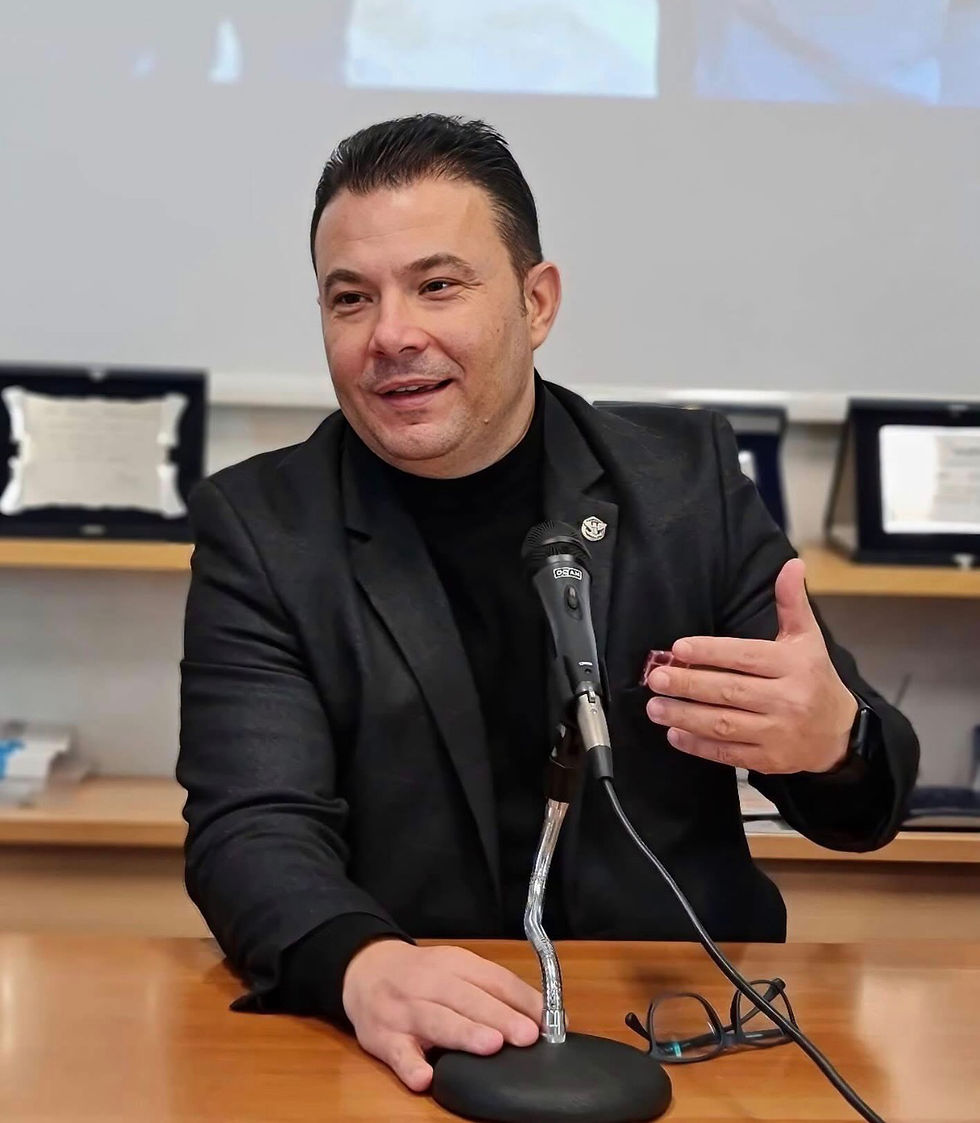
On March 27, 2026, in the Public Library of Vlora, my book Neoshqiptarizmi (NeoAlbanianism) lay on a plain table, its quiet red turned toward a room that had gathered for something weightier than a cultural occasion.
Some afternoons disappear the moment the chairs empty and the doors close behind them.
Others remain, testing the mind long after the hour has passed.
This was one of those.
Because what stood before us that day was not only a book, but a question, whether we still possess the strength to hear an idea that asks not for comfort, but for burden.
The hall was filled with intellectuals, poets, writers, scholars, citizens, and young people from Vlora.
Their presence gave the afternoon more than attendance, it gave it gravity.
A book that tries to speak to Albanians about roots, freedom, family, nationhood, the West, and the future does not prove itself by the stir it creates, but by the quality of attention it can command.
That afternoon, attention had silence in it, and silence had dignity.
To me, that mattered more than any quick approval that rises fast and disappears just as fast.
Laureta Petoshati spoke.
Albert Abazaj spoke.
The leaders of the Public Library spoke.
Prof. Gjergj Sinani spoke. I spoke as well.
Each brought something the hour required. Laureta Petoshati brought the clarity of scholarship and the poise of a mind that understands what culture must carry in public life.
Albert Abazaj brought the sensitivity of a poet who knows when language must stop adorning and begin to weigh.
Prof. Gjergj Sinani gave the gathering the authority of philosophical reflection and the composure of serious thought.
The Library’s leaders gave the occasion that institutional humility without which no event of culture acquires true honor.
Their regard for the book, and for me, did not lighten what I had to say.
It made it heavier.
A word that is honored loses the right to be light.
My gratitude to the Public Library of Vlora is deep and clear.
Not only for the invitation.
Not only for the care with which the event was arranged.
But for the way its meaning was understood. Some libraries preserve books.
Others preserve the possibility that a book may once again become a meeting between a city and itself, between memory and time, between culture and public life.
That afternoon, the Public Library of Vlora did not simply open its doors to an author.
It opened to a city the chance to hear an idea that seeks to enter Albanian life not as the fashion of the day, but as a way of bearing itself.
And none of this can be separated from Vlora itself.
For Vlora is not, to me, merely a city of striking landscape, nor merely a radiant name in Albanian history.
It is one of the places where the history of this nation took visible form.
It is the city of proclamation, the city in which the Albanian will to be master of itself stepped into the light.
It is a city where the sea has not been only horizon, but opening, where the shore has not been only shelter, but departure, where memory has not been only longing, but character.
In Vlora, Albanian identity did not remain a feeling alone, it took on shape, responsibility, and decision.
That is why it is no accident that a book like Neoshqiptarizmi (NeoAlbanianism) found there not merely a hall, but ground.
For me, Vlora was never simply the site of a book launch. It was a place of return.
I lived there through some of the most beautiful years of my early youth.
I feel, in a real sense, that I am one of its sons.
To return there with Neoshqiptarizmi in my hands was a rare emotion.
There are cities one passes through.
There are cities that enter the inner composition of a life.
Vlora, for me, is one of those.
That is why the afternoon did not feel like a date in an author’s calendar.
It felt like a return to one part of my life carrying a new weight on my shoulders.
Yet the true meaning of that afternoon does not lie only in the honor of hospitality, nor only in the quality of those who spoke, nor only in the pull of personal memory. It lies in the book itself.
What is Neoshqiptarizmi (NeoAlbanianism)? Why did I write it?
What does it seek to give the Albanian nation in this hour?
I did not write this book to add another title to a shelf.
I did not write it to coin an ideological label that might circulate briefly and then vanish.
I did not write it to flatter a pride already pleased with itself.
I wrote it because Albanians today are facing a grave trial, how to enter the future without leaving the homeland outside themselves.
Albania is emptying out.
Generations are breaking apart.
Public language is thinning.
Attention is scattering.
Standards are fading.
Modernity is too often mistaken for imitation, freedom for ease, development for uprootedness.
Around us, the world is entering once again a harsher season, one in which small nations risk losing not only their weight, but their inward form.
In such a climate, a people may continue to move and still fail to rise, may continue to walk and yet no longer know what they live for.
A small nation does not perish only when it is struck from without.
It also perishes when it allows itself to dissolve from within, until language, memory, family, honor, and even the sense of belonging retain a name but no longer hold a living form.
It is precisely against that dissolution that I wrote Neoshqiptarizmi (NeoAlbanianism).
I wrote it to say that roots are not an obstacle, but the condition of ascent, that modernity is not self-erasure, but a trial of character, that being pro-Western is not a façade, but a moral, institutional, and civilizational responsibility, that the nation is not ceremonial ornament, but a community of memory, duty, and future, that the family is not a cliché, but the place where character, limit, responsibility, and the keeping of one’s word begin.
I wrote this book so that Albanians may not become people of the new age with technology in their hands and a homeland gone dark within them.
After that sentence, everything else, for me, must grow quieter.
There lie my fear for the age and my hope for my people, that we not enter the new era as an imitation of the world, but as a people with a face, with honor, with memory, and with a freedom that does not tear itself away from its own roots.
That is why this book seeks to render a service. Not merely to offer ideas.
Not merely to produce polemic.
Not merely to stir reaction. It seeks to restore form.
To remind Albanians that without roots there is no rising, without family there is no formation, without nation there is no full responsibility, without justice there is no inward peace, without culture there is no civilization, and without honor there is no freedom that endures.
If this book succeeds in awakening a deeper awareness of that truth, then it will have fulfilled the reason it was written.
And in Vlora, that afternoon, I felt that this service had been understood.
Not as dogma. Not as slogan.
Not as ornament of language.
But as necessity.
As the need to think more clearly, to stand more rightly, and not to enter scattered into a time that scatters everyone.
That is why the gathering will remain with me as more than a beautiful memory.
It will remain as proof that Albania still has cities in which a book is not treated as a passing object, but as a burden that gives thought its proper weight.
In the end, what remains from Vlora is not only the presentation of a book.
It is the fact that a city agreed to give a dignified hearing to an idea that seeks to speak to Albanians about roots, freedom, family, formation, the West, and their own future.
In an age when much is said and little is truly heard, that is not a small thing.
It is one of the ways a society keeps its honor from dwindling into nothing more than a name.

Comments